
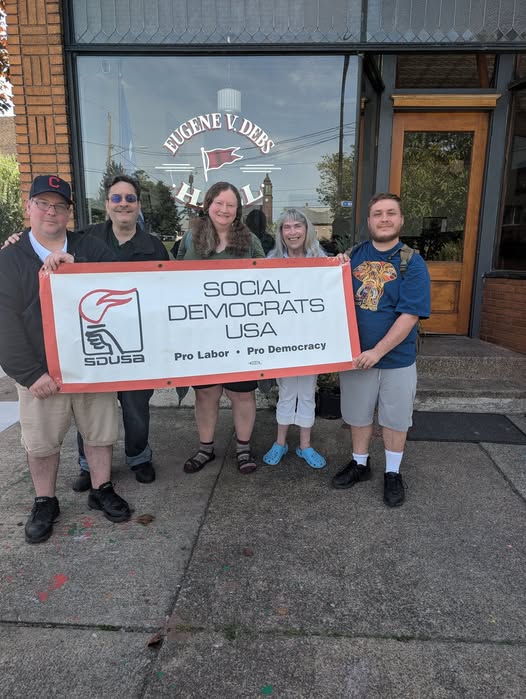
The 2026 National Educational Conference of Social Democrats USA continued through Labor Day weekend in Buffalo, New York, bringing together members, candidates, organizers, and activists for several days of discussion, political education, grassroots organizing, and participation in Buffalo’s Labor Day traditions. Days Three, Four, and Five brought the conference’s work into particularly sharp focus.
Day Three concentrated on electoral campaigns and the lessons candidates were learning from voters on the ground. Day Four took those discussions into the streets through participation in Buffalo’s Labor Day parade. The final day then turned toward organizational development, grassroots activism, and a broader discussion of what distinguishes social democracy from other traditions on the left. Together, the three days emphasized a common theme: political organizations have to connect ideas with practical work, campaigning, organizing, participating in labor and community movements, and delivering tangible results.
Day Three: Candidates, Campaigns, and Lessons from the 2026 Elections
Day Three began with interviews with candidates who had recently participated in contested elections, giving conference participants an opportunity to hear directly about the experience of campaigning, communicating with voters, and building political coalitions.
Anne Parelkar on campaigning in Kansas
Anne Parelkar, who discussed her campaign for the U.S. Senate in Kansas, described the race as her first experience running for elected office. She said that the campaign had been demanding but had provided an enormous amount of experience and had brought together supporters from Kansas, across the country, and internationally.
One of Parelkar’s principal lessons concerned political labels. She argued that words such as “socialist,” “Democrat,” and “Republican” can cause voters to make assumptions before hearing a candidate’s actual position. Her campaign therefore sought to emphasize common concerns and concrete needs rather than allowing the conversation to be defined solely by ideological labels. Parelkar also discussed the importance of distinguishing between ordinary political disagreements and genuinely extremist or oppressive positions. She said candidates should be willing to have conversations with people across political differences while recognizing that some people may not feel safe engaging with individuals advocating explicitly discriminatory or authoritarian positions.
She identified misinformation, social media, and the need for greater accountability from elected officials as major challenges facing political organizing. She also emphasized the importance of engaging younger voters and finding ways to convince more young people that participation in elections matters. When asked about Kansas issues, Parelkar identified data centers and healthcare as particularly important concerns. She connected those issues to a larger argument for antitrust enforcement, stronger unions, and reducing the concentration of economic power in large corporations.
The Democratic Party and candidate support
A significant portion of the discussion concerned Parelkar’s experience with the Johnson County Democratic organization. According to Parelkar, the organization had established conditions for receiving certain forms of campaign support, including a requirement that candidates demonstrate that they were running a “serious” race. She said fundraising became a determining factor and that she challenged the decision because of the substantial volunteer effort invested in her campaign.
Parelkar said she believed the episode illustrated a broader tension between party organizations and grassroots candidates. In her account, volunteer labor and the participation of people who could not afford to make large financial contributions deserved to be valued alongside fundraising. She emphasized that her criticism was directed at the process rather than every individual within the Democratic Party, noting that she had also received support and guidance from Democratic officials elsewhere in Kansas. She ultimately argued for a political culture in which people do not have to personally like one another to work together. “We don’t have to be best friends,” she said, but people can still be on the same team when they share a commitment to accomplishing something positive.
Taylor Moreland and rural Kansas
The conference then heard from Taylor Moreland, a candidate for the Kansas House in House District 7 in southeast Kansas. Moreland explained that her decision to run came in large part from her experience working in the foster care system. She described seeing firsthand the difficulties facing children and families and concluded that more lawmakers with direct experience of working class life and public institutions were needed. She said she wanted government to pay greater attention to people’s lived experiences rather than focusing primarily on statistics and institutional interests.
Moreland described voter contact as one of the most challenging and rewarding parts of the campaign. Because she had relatively few volunteers, she personally conducted a substantial amount of voter outreach. She also deliberately reached out to Republican voters, arguing that an elected representative would ultimately represent everyone in a district, regardless of how they voted.
Her campaign also illustrated the importance of learning from constituents rather than assuming that candidates already understand every local issue. Moreland said she had spoken directly with farmers and ranchers to learn about agriculture, an especially important subject in a rural Kansas district. The issues she heard most frequently included property taxes, marijuana legalization, healthcare, and the future of rural hospitals. She also discussed growing local concerns about energy, water resources, and the environmental implications of nuclear projects and proposed data centers in and around Parsons. Moreland told the conference that volunteers could help through phone banking, campaign outreach, and other forms of grassroots activity. Conference participants also discussed helping with phone banking later in the campaign.
Looking across the 2026 election landscape
The candidate discussions were followed by a broader analysis of the 2026 elections presented by Sheldon Ranz. Ranz focused heavily on the campaign and political development surrounding New York City Mayor Zoran Mamdani, using it as a case study in grassroots campaigning, electoral strategy, and the relationship between candidates and established political institutions.
A major theme of the presentation was direct voter contact. Ranz described Mamdani’s campaign as having developed an extensive ground operation and highlighted efforts to reach voters personally, particularly in communities where the campaign was facing political opposition. Ranz also emphasized the importance of governing after an election. He discussed the Mamdani administration’s approach to rent stabilization, expanded healthcare for young children, and municipal infrastructure. He presented these activities as examples of a “sewer socialism” tradition in which local government demonstrates its political program through concrete improvements in daily life.
The presentation then examined Mamdani’s endorsements of other candidates and argued that electoral organizations should assess not only whether candidates share their political outlook, but also the actual circumstances of the races in which they are competing. Ranz described this as a lesson in strategic realism, particularly when deciding where organizational resources and political influence can make a difference. The broader discussion included examples from Seattle, Michigan, Wisconsin, and elsewhere, with the presentation arguing that the electoral developments of 2026 were part of a wider national political landscape rather than being confined to New York City.
Day Three therefore concluded with a practical lesson for organizers: successful campaigns require more than attractive platforms. They require sustained voter contact, knowledge of local conditions, coalition building, careful strategic choices, and the ability to connect political ideas to concrete concerns.
Day Four: SDUSA in the Buffalo Labor Day Parade
Day Four moved the conference from discussion to public participation.
Conference participants joined Buffalo’s annual Labor Day parade, an event organized through the AFL CIO and its affiliated unions. The parade provided a direct connection between SDUSA’s educational conference and the city’s labor movement. The parade itself was described as a major Buffalo tradition. Participants marched through
broad city avenues while residents gathered outside their homes to watch and cheer the
marchers. The atmosphere created an unusually direct interaction between the labor movement and the surrounding community, with families and children treating the parade as an annual civic event.
The march lasted approximately an hour and a half to two hours. Members of SDUSA
participated alongside the broader labor community, making the Labor Day event a practical expression of the conference’s emphasis on connections between social democracy, organized labor, and community activity. The day also produced an unexpected opportunity for public outreach. Conference participants were interviewed by a local newspaper and photographed during the event. After the march, participants returned to Debs Hall, where they continued interacting with grassroots activists involved in the Labor Day festivities and a bicycle ride.
The significance of Day Four was therefore not simply ceremonial. The parade placed
conference participants directly alongside the labor movement in a public setting and provided an opportunity to interact with workers, residents, activists, and other community participants outside the conference room.
Day Five: Organizational Growth and the Meaning of Social Democracy
The final day turned inward, focusing on what participants had learned and what they intended to do with it. Sheldon Ranz began the closing discussion by highlighting SDUSA’s organizational growth. He said the organization had fewer than 50 members when he joined in 2016 and was approaching 200 members in 2026. He also said that the organization’s financial resources were stronger than they had been during his decade of membership, allowing SDUSA to organize a conference of greater scope and duration than it had been able to hold in earlier years.
Ranz used the New York City chapter as an example of how a relatively small organization could generate political relationships and public activity. He discussed SDUSA’s contacts with Mayor Mamdani, efforts to develop additional relationships with political and peace organizations, and plans for further activity in New York. The larger organizational lesson was that SDUSA’s resolutions are intended to lead to action. Ranz encouraged members to organize local chapters and use the organization’s resolutions as starting points for community activity. He noted that five dues paying members are sufficient to establish a chapter and argued that organizational resolutions should serve as guides for practical work rather than remaining statements on paper.
Defining social democracy
The final major intellectual discussion of the conference centered on the question of why SDUSA calls itself social democratic. Patty Friend presented a series of statements written in the style of historical social democratic figures and used them to explore the distinctions between socialism, democratic socialism, and social democracy. The exercise explicitly asked what social democracy means and why SDUSA identifies with that tradition.
The first statement, presented in the style of Max Shachtman, contrasted social democracy with both unregulated capitalism and authoritarian forms of state collectivism. It described social democracy as combining economic justice with political liberty through institutions such as progressive taxation, universal healthcare, strong unions, and public investment.
The second, written in the style of Bayard Rustin, connected economic democracy to the traditions of the civil rights and labor movements. It argued that formal political rights are incomplete when people lack meaningful access to economic security and linked social democracy to full employment, healthcare, housing, education, and strong unions. It also emphasized coalition building among labor, the Black freedom movement, liberals, and the democratic left.
The final statement drew the clearest distinction between democratic socialism and social democracy. It described democratic socialism as ultimately seeking social or public ownership of major parts of the economy through democratic means, while presenting SDUSA’s social democracy as a distinct approach centered on achieving economic reforms and greater democratic control through existing political institutions. The discussion therefore framed social democracy not as political passivity, but as a specific strategy for pursuing economic and social reforms through democratic institutions, organized
labor, elections, and sustained grassroots activism.
From Education to Organization
The closing sessions returned to a theme that had appeared throughout the preceding days: education is valuable only when it produces action. The candidates on Day Three spoke about knocking doors, talking with voters, learning local issues, building volunteer organizations, and adapting campaigns to the communities they hoped to represent. Day Four put conference participants directly into Buffalo’s labor movement through participation in the Labor Day parade. Day Five challenged SDUSA members to carry the same spirit of practical organizing back into their own communities.
The conference’s closing message was therefore both organizational and political: members were encouraged to build chapters, participate in local movements, support campaigns and community efforts and turn SDUSA’s adopted principles into practical work. The final discussion also placed that organizing work in a larger historical framework. Social democracy was presented as a tradition concerned with linking political democracy to economic security, supporting organized labor, expanding access to healthcare, housing, and education, and pursuing change through democratic means.
Looking Ahead
The 2026 Educational Conference ended in Buffalo with SDUSA reflecting on both its past growth and its future responsibilities. Day Three demonstrated the challenges and possibilities of electoral politics through the experiences of candidates in Kansas and the wider lessons participants drew from the 2026 elections. Day Four connected the organization to the labor movement through Buffalo’s Labor Day parade. Day Five focused on the organization’s expanding membership and resources, the development of local chapters, and the continuing discussion over how social democracy should be understood and practiced.
The conference ultimately presented political education, electoral organizing, labor participation, and grassroots activism as parts of the same larger project. For SDUSA, the conclusion of the conference was not an endpoint. It was a call for members to take the ideas discussed in Buffalo and carry them back into their own communities, building organizations, participating in movements, supporting democratic candidates and causes, and working toward the social democratic goals that brought the organization together in the first place.